In today’s crowded digital landscape, a successful content strategy is about more than just publishing. It’s about choosing the right format for the right audience and the right goal. But with so many options, from Google Business Profile posts to blog articles and in-depth resource articles, how do you know what to use when? This report cuts through the noise, breaking down the unique purpose, investment, and benefits of each to help you build a smarter, more effective content plan.
Google Business Profile Post
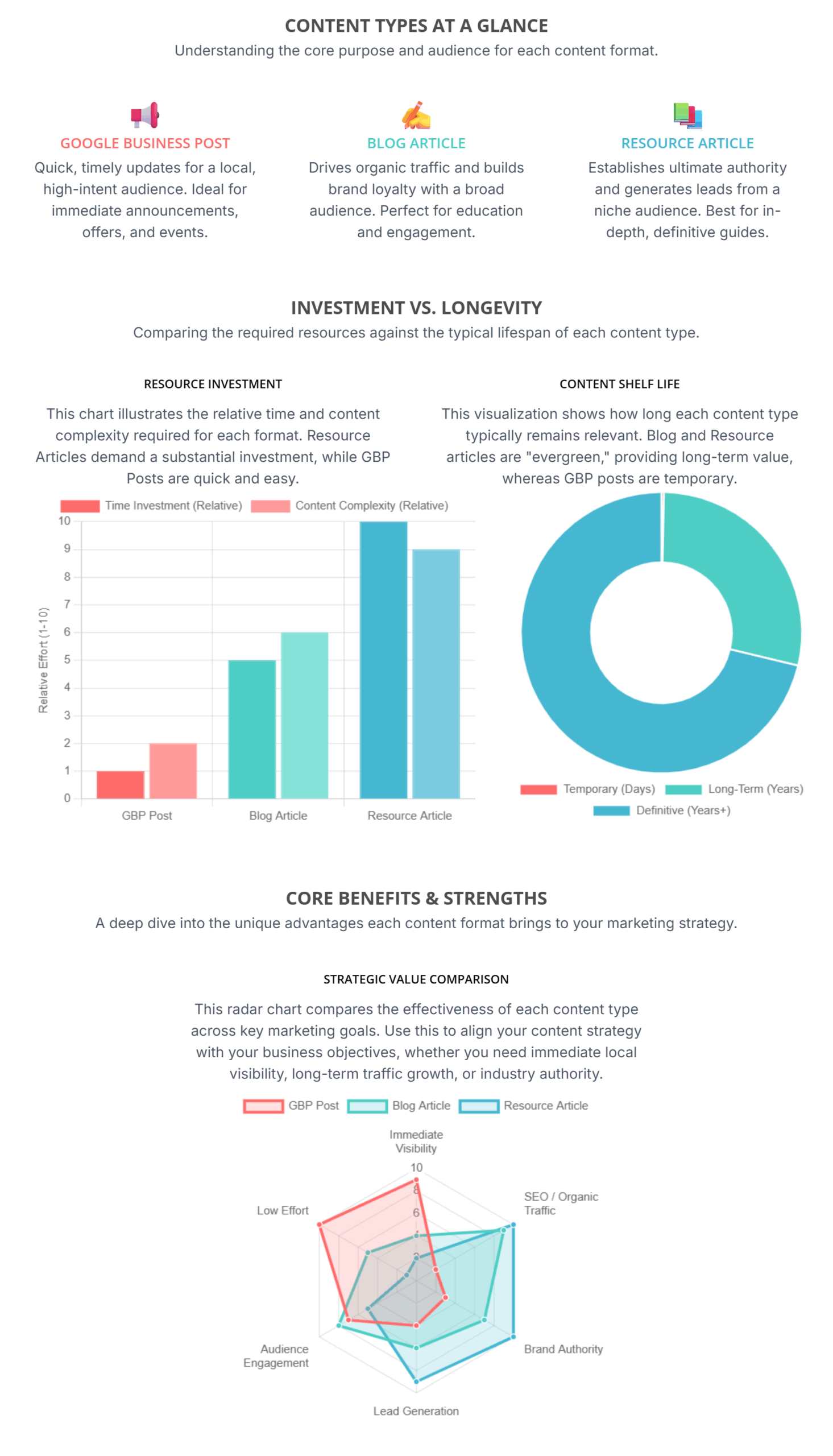
A Google Business Profile (GBP) post is a short, timely update displayed directly on a business’s Google Search and Maps listing. Its primary purpose is to provide immediate, localized information to customers who are already actively searching for a business or a service in their area.
- Key Characteristics:
- Length: Very short, typically 80-100 words.
- Shelf Life: Posts are temporary, often expiring within 7 days, unless a specific date range is set for an event or offer.
- Tone: Direct, conversational, and often action-oriented.
- Content Type: Can be an update, offer, event, or product highlight. Includes text, an image/video, and a call-to-action button.
- Resources Needed:
- Time: Minimal. Creating a post is a quick process, often taking just a few minutes.
- Content: A brief, punchy message and a relevant image or video.
- Platform: Access to a Google Business Profile account.
- Benefits:
- High Visibility: Appears at the top of a business’s profile on Google Search and Maps, reaching potential customers at a critical decision-making point.
- Increased Engagement: Can drive direct customer actions like calls, website clicks, or inquiries.
- Free and Easy: It is a no-cost, low-effort way to keep your profile fresh and engaging.
Blog Article
A blog article is a piece of long-form content published on a company’s website. Its goal is to attract new website visitors through search engines, build brand authority, and nurture relationships with an audience by providing valuable and engaging information.
- Key Characteristics:
- Length: Longer form, typically ranging from 500 to 2,000+ words.
- Shelf Life: “Evergreen” content that can remain relevant for years, continually driving organic traffic.
- Tone: Varies from informal and conversational to more professional, depending on the brand voice.
- Content Type: Educational content, company news, industry insights, or personal stories.
- Resources Needed:
- Time: Significant. Requires research, writing, editing, and publishing.
- Content: Requires a deep understanding of a topic, keyword research for SEO, and high-quality writing.
- Platform: A website with a dedicated blog section.
- Benefits:
- Organic Traffic: Attracts a wide audience from search engines, which is crucial for long-term growth.
- SEO Boost: Regularly updated, quality content helps improve a website’s search engine rankings.
- Brand Authority: Establishes the business as a knowledgeable and trusted leader in its industry.
- Customer Relationships: Provides a platform for in-depth engagement and relationship-building with an audience.
Resource Article
A resource article is a highly detailed, data-driven, and authoritative piece of content. While similar to a blog article in its long-form nature and purpose of educating, it is distinguished by its extensive research, formal tone, and function as a definitive guide or reference.
- Key Characteristics:
- Length: Very long, often exceeding 2,000 words.
- Shelf Life: Designed to be an evergreen, foundational piece of content.
- Tone: Highly formal, objective, and well-researched.
- Content Type: In-depth guides, comprehensive tutorials, white papers, or heavily-researched reports.
- Resources Needed:
- Time: Substantial. Requires extensive research, data collection, and rigorous editing. Often a significant investment.
- Content: Requires deep subject matter expertise, citations, and a structured, logical argument.
- Platform: Typically housed on a company’s website, often in a dedicated “Resources” or “Knowledge Base” section.
- Benefits:
- Ultimate Authority: Positions the business as the definitive expert on a particular topic.
- High-Value Backlinks: High-quality resources are likely to be cited by other websites, which significantly boosts a site’s SEO.
- Lead Generation: Can be used as gated content to capture leads and grow an email list.
- Customer Education: Serves as a reliable reference point for both current and potential customers.
| Feature | Google Business Profile Post | Blog Article | Resource Article |
| Purpose | Timely updates to local customers | Drive traffic and build brand loyalty | Establish ultimate authority and generate leads |
| Length | Short (80-100 words) | Medium (500-2,000+ words) | Long (2,000+ words) |
| Shelf Life | Temporary (typically 7 days) | Long-term (“Evergreen”) | Definitive (“Evergreen”) |
| Resources | Low time, simple content | High time, high-quality writing | Very high time, extensive research |
| Audience | Local searchers, high-intent | Broad audience, casual readers | Niche audience, high-intent |
| Benefit | Immediate visibility and action | SEO, brand building, traffic | Authority, backlinks, lead generation |
Ultimately, the most effective content strategy isn’t about choosing just one of these formats, but about understanding how they all work together. Use Google Business Profile posts for quick, localized updates, rely on blog articles to build organic traffic and brand authority, and leverage resource articles to establish your business as a definitive expert. By strategically deploying each content type, you can create a robust and dynamic digital presence that drives both immediate engagement and long-term success.